Showing posts with label programs. Show all posts

10.10.2017

1000 Books Before K Resuscitation


After reading Jenni's recent post at From the Biblio Files on re-launching her library's 1000 Books B4 K program, it got me thinking - what are keys to continuing success in a long-term program? How can we keep it fresh?

From my observations and listening on my consulting travels and in my CE teaching, I have gathered a few clues particularly about 1000 Books programs.

Do Ongoing Promotion 
- Long-term programs need far more continual marketing.
- Work through schools, preschools and child care centers to get the word out at parent nights, through newsletters, at preschool and kindergarten screenings and registration, in pediatric clinics at baby "showers" or preschool fairs and celebrations.
- Present at service organizations to keep the word circulating in the community.
- Meet with your United Way, Literacy and Reading councils, communities of practice and any other professional organization and promote the benefits of parents and kids reading together and library use.
- Do annual press releases and send annual short-reports to your elected officials, board and to your library networks.

Do Specific Active Programs to Support This Passive Program
- Hold annual "graduation" parties for participants.
-Open the library before or after hours for 30 minutes and invite parents and kids to spend time reading together. Consider serving a snack, having a costume character come by or another short activity to get them excited.
-Hold an annual celebration with a performer or concert to celebrate the number of total books read and visits made to the library (every 100 level sheet bookmark equals 100 books and one visit to the library). Before you know it, you have some powerful stats to share!)

Don't Let the Materials Get Tired
Jenni hits the nail on the head with her changes. Restructure your theme; restructure your 100 level sheets to make them easier; restructure your incentives. A good hard look can suggest ways to make the program less cumbersome and more inviting.

Change Your Visuals
Consider updating your wall or door display that charts kids' progress. Make it bright and interactive like Knutson (Coon Valley WI) Memorial Library. They purchased pre-made material and added little kid craft stick people that kids could move up the chart. A little play literacy goes a long way!


Don't stay stuck on your theme. La Crosse Public Library changed from flowers to trucks for their wall progress chart and use zoomed up again!
Change out your poster and handout designs often. When people see the same thing repeatedly, they stop "seeing" it.

What are YOUR go-to methods to keep your long-standing programs fresh?

Note: For more information on 1000 Books programs , research to use, how to set them up, where they started, etc, stop here.


1.08.2015

Need More Programming Chops?


Pixabay Image
One of the most difficult parts of our work is often giving ourselves permission to try new things in our programming.  Sometimes we feel pressure from our administrators, our veteran colleagues or patrons to do - or not do - certain things. Combine that with tight budgets, tight staffing and tight time and the challenge really ramps up. We read exciting efforts in blogs and online but just can't seem to jumpstart them at our own place of work.

If you are looking to re-think, get re-inspired or explore programming a little more in depth, I invite you to join me in an upcoming online CE course: Power Children's Programming on a Budget.

This asynchronous course which starts on January 26 and runs for six weeks gives participants a chance to learn - and share experiences and tips that work wonders. We also explore strategic ways to plan, be a strong advocate and fit what you want to try into a busy work schedule. A bonus is our blog that will preserve ideas and thoughts.

Whether you live in Wisconsin or another state, this course is a great one to hone your programming skills! Hope you can join me!


11.14.2014

Programming Superheroes


Image: Pixabay
That's what we youth librarians are, you know.

I've been thinking alot about programming over the past couple of years. I've been writing about it, teaching about it, listening to ideas about it, revising my thinking about it and considering it in the context of all we do as youth librarians in our work day.

And one consistent theme that has struck me is that programming for kids in libraries - while not all we do - is the part of our jobs that is most visible, touches children's hearts most closely and consumes a great deal of our creative and imaginative energy.

We come into work, don our superhero librarian costume and plan and present amazing early literacy storytimes; school age programs, outreach visits and more. We think about how to involve kids through passive programs, DIY programs, partnerships with other organizations.

Back in our "Barbara Gordon" street clothes, we scan Pinterest, blogs and journals for new programming ideas. We talk to our colleagues, watch webinars, brainstorm and dream new ways to reach kids through our programming. We see program possibilities while we shop for groceries, stop by a festival, in our jammies while watching TV.

All the ideas get tucked away and pop back out when we don our superhero duds back at the library.

Part of being a superhero is finding ways to take those ideas and balance them to serve people without burning out. So we share tips on how to do programming and collection development and planning and advocacy and all the background tasks that make up a whole youth librarian's M.O. in a sane, fun and sustainable way. The hidden secret identity parts of our work are less visible to our public but just as heroic.

We recently received a lovely tribute to our youth staff- both past and present - from a patron whose children's reading lives were touched by staff helping the find the perfect book and presenting great programs.  These glimpses into the change we make as very public programming superheroes and quieter reader's advisors and information professionals reveal the depth of our good work. We all receive these positive boosts from our patrons and they warm our superhero hearts.

Whether thanks are expressed or not, the work we do to shine a light on literacy, learning experiences, and reading through our programming touches the lives of children and brings us out to them and them into our libraries.  Shine on, my superhero colleagues, shine on!

3.03.2014

Don't Forget the Databases


We are big believers here in using a variety of program types to fill out our dance card. By combining active, DIY and stealth/passive programs, we create time in our schedule to

  1. serve all ages 
  2. incorporate more outreach to schools and daycares
  3. do stronger collection development
  4. blue sky and write successful grants to support new initiatives
  5. provide time for CE time for staff (PLNs, webinars, in-person attendance and networking)

So just what are these program types?

Active programs can be simply characterized as programs a staff or volunteer present or lead: storytimes, afterschool workshops, parties based on book characters or popular subjects, STEAM

DIY programs can be thought of as times or spaces devoted to kids in the library that allow them independently to manipulate materials. Think of scavenger hunts, art and craft materials set out for kids to make things, Story Action Pods, imaginative play stations for any age.

Stealth programs are those that, once prepared by staff, are totally powered by the kids and families. They provide the reading or return visits to the library. SLP is a great example we all do. 1000 Books Before Kindergarten is another great example.

We keep track of how participation/attendance is in all the programs. How many kids used the story action pod (based on number of sheets of paper used); how many bags of legos were give out at check-out for Lego Tower Build; how many children attended storytime; how many return visits were made for 1000 Books Before Kindergarten this month? These stats help us stay informed of the usefulness of each effort.

We keep a fairly simple database of our programs and numbers to help us track participation. At some libraries, an excel spread sheet works; others use a paper copy. By keeping statistics on our programs – and referring to and studying them for patterns and trends - we make informed decisions on what programs should be continued, when to end programs and the types of programs that fit best within our budget, staff time and community needs. This analysis and evaluation becomes second nature and gives us the support we need to expand, delete or add programs based on hard facts rather than supposition.

These statistics not only inform us, our director and our board, but we also report out these numbers to the state library for the state annual report. Sadly, for a long time, although we did this mix of programs, only our active program statistics and SLP participation were reported to the state for the annual report. Winter reading program? Too bad.  Lego Build effort - no way. Cookie Club? You dreamer! 1000 Books Before Kindergarten? Nope.

That was a problem. In our state youth librarians started working hard to change that dynamic. Our state library folks could see the efforts and time that went into DIY, reading programs beyond summer and passive programs that brought children and families into the library. They became champions of change in the reporting of youth program statistics. To get a peek at the results of that work in Wisconsin, check out this PDF of the new reporting system and definitions for programs.

Now ALL.THE.THINGS.COUNT. It makes it easier as a manager to justify our hard work. And it makes me glad we have our database of program stats for all types of programs that shows what happens when we reach outside the box of traditional programming and bring it to our community!


2.24.2014

Give It Away, Give It Away, Give It Away Now


How often do you go to a program, read a blog post, see a blog comment or in conversation with your colleagues hear, "I stole this program."

You guys, no you didn't!!!!

I feel very strongly about this issue.  We all share so that we all can learn. This issue came up in our programming class and one of the student-librarians wrote this post on our class blog Kids Library Program Mojo.

Each description or workshop or blog post on a program or idea is really an open invitation to take the idea and grow it for YOUR community.

Remember, if you don't use that idea, it stays hidden and the children in your community never get the benefit of that innovation.  Hidden ideas seldom grow, evolve and change.

It's within the scrum of sharing, borrowing and giving away of ideas that we see the true evolution of innovation in children's library work. Be good and credit your source and the originator always and then grow it!

Sandy Krost started 1000 Books Before Kindergarten - look where it is now.

Sara Bryce pioneered Story Action Pods - look where it is now.

Cory Eckert started the Guerrilla Storytime movement - look where it is now.

Mel Depper started the Flannel Friday movement - look where it is now.

Lisa Shaia just started the school age Thrive Thursday movement - look where it is now.

I had a hand in starting the Unprogramming concept - look where it is now.

I could go on...but these are all incredible new, crowd-sourced initiatives that have grown like topsy because we share - and give ownership and agency away.  It is good to know you started the snowball rolling but why do you have to hoard the snow that goes into making it bigger, better and shared across the area, state, region or nation?

Any one of these things would still exist if it were "owned" by its founder in some small way, in one small community, in one lonely place.  But by giving it away, inviting participation, sharing and sharing, all of these innovative children's initiatives, projects, programs and concepts have taken on a vibrant life of their own.

We are stronger together. So free yourself.  Give it away. Take it. Share it. Grow it. Fairly credit it. And be mighty.


2.18.2014

Global Connections


Our library has really been encouraging staffers to step up and out and program. The fun part about this is that staffers from all departments and all position levels have been able to pursue program dreams that add a richness and excitement to our offerings.

The Children's Department benefitted this weekend from the good ideas of a colleague in the Circulation Dept. She had the idea to involve international students from our university in sharing information about their countries and cultures at a two hour fair.

The advisors for the students were enthusiastic. Although we had booked our basement auditorium, we made the decision to locate the students right in the Children's area and the program room. We thought this would make this more lively for the students and less intimidating for the kids who came. With a few extra tables and chairs, we were ready.
We had students from China, Hungary, Japan, Vietnam, India and Laos.  They brought games, toys, posters, maps and dressed in or brought along traditional clothes from their respective countries.  The Chinese students shared a dance and the Vietnamese students shared a bamboo stick dance.

It was clear that these students missed being around young kids. They were delighted to play with them and spend time with the kids who came. By holding the event for two hours, it gave kids plenty of time to go from station to station and discover what each student group had to share.


As staffers, we took photos, helped introduce families to the layout and enjoyed ourselves. Plans are in the works to do this program again in fall. Next time, we'll provide more book displays, a "passport" listing the station countries to visit and stampers for the students to stamp the passports.

This is the kind of fortunate partnership - both with a colleague from another department in the library and with a local group  - that really enhances the caliber of our programs. We feel lucky to have this kind of support in our library and community!

2.13.2014

Programming Happiness

I'm over at the brand new blog, Kids Library Program Mojo today sharing our students' thoughts on what gives them happiness in their programming work.

The blog will be active over the next few months as a vehicle to share thoughts, discussion and work of our Power Children's Programming on a Budget spring online CE class for UW-Madison SLIS. Hope you can follow the fun and join in the discussions through the blog comments!


1.07.2014

Now That's Toothsome!


One of my favorite stand-alone programs for kids involves dental health and teeth. Since Dental Health Month is around the corner, I thought I 'd share.


Books to Read:
Clarabella's Teeth - An Vrombaut
Bear's Loose Tooth  - Karma Wilson

Story to Share:
Bill and Pete - Tomie DePaola (because having a bird as your toothbrush is too good to pass up!)

I use a crocodile puppet and a little bird finger puppet and tell the first half of the story where Bill gets a bird, Pete, as his toothbrush (and friend). They both go to school and Bill learns to spell his name with Pete's help.

Activity
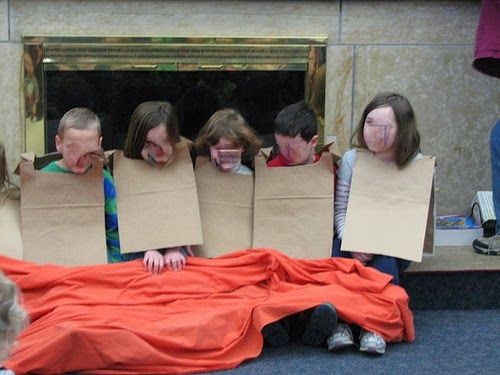
Cut the sides out of brown paper grocery bags and a scooped hole in the top for kids heads to go through. Tape white paper on one side. You now have a clean tooth and a dirty tooth!

Ask for some of the kids to be your helpers. Have them sit side by side and cover their legs with a pink sheet or large cloth (they are now teeth with a gum around them!). Slip the "tooth" bag over their head with the brown side in front.

Use a large toothbrush (borrowed from a dentist or your health department) to brush the teeth and a piece of rope to floss them and talk about how much fun brushing teeth is. Then turn the bags around to the white side!
The teeth need brushing
Clean teeth!


This giant demonstration never fails to please. And if you are lucky, a tooth fairy may appear to help get those teeth brushed and flossed.


11.19.2013

Learning When to Say "End!!"


One of the truly bright spots of youth librarianship is the sheer fun and creativity - the inventiveness  - of our programming work with kids and families.  Program series and "one-up" events for school-agers let us experiment with unprogramming, DIY, STEAM and lots more stuff we make up with joie de vivre, an eye for literacy and a celebration of our collections. Storytimes present an ever-flowing river of great new books to try, a fingerplay or way to deliver a literacy tip, new CDs to share, a new way to engage the kids. Over at Storytime Underground, a great example of this flow is their "Pimp My Storytime" post (go over and play now!).

But, we also know that, as good as our ideas are and as often as they work swell, the time comes when the program or format just isn't making it anymore - either for the patrons or for us.  The trick is to know when to say when - when to make a major change in direction or end a limping program.

What are some of ways that you feel the winds of we-may-need-to-change?
  • Attendance drops off.
  • The format of your school-age programs hits even you as routine.
  • You begin to dread your next storytime session.
  • The preschoolers seem antsy ALL the time (no blaming barometric pressure or the full moon there).
  • Trying new times, days, or scheduling patterns don't resurrect patron interest.
  • The same small group of dedicated patrons come, but no one new ever does.
  • Budget cuts loom and something has to go or be cut back.
As a librarian and a manager, I have presided over countless changes in my own programming and in the departments I oversee. I find change exhilarating, evolutionary and necessary to move youth services ahead. Despite those feelings, I also know: Change.Is. Hard.  It is scary ("Is that a cliff I see ahead?!?!"). It is unknown ("Is this gonna work?!?!).  It is stressful ("Are patrons gonna hate on me?!?!").

At the same time, these program tweaks, changes and endings can allow an opening up of possibilities. New information, new ways of providing service or new ways to emphasize collections can be developed and enfolded into a re-working of a program or program schedule.

This reflection on worth is something that ideally is ongoing. When we talk about changing or ending something, we often find the opportunity to add something else - new outreach to kids in schools/daycare; a stealth program; clear the schedule to bring in a whole district-full of field trip visits (Kindergartners! 2nd Graders! 7th Graders!); time to write a grant for a way new initiative. 

When we talk to our patrons about the changes, they are often happy to see the additions and changes. Sometimes we have a few who question why we are making a change or express unhappiness. We find that, as a staff- and at all service points, explaining why we are doing what we are doing often makes a difference in understanding.

Sometimes our fear of the unknown, fear of community reaction or our own sense of being wedded to a certain program we birthed and proudly watched grow prevent us from making the change or bringing the end to a program.  But if we want to move forward, if we want to balance what we do so we can add a fresh program or start, it is OK to put a final period on a certain program.

How about you?  Are you able to do guilt-free program ending/change?

Graphic courtesy of Pixabay

9.13.2013

An Eye for the Future - Part 4


In this series of blog posts, sustainability is the watchword.  We've looked at issues and thoughts about project costs and grant fails and triumphs. In this final post, let's consider the sustainability factor in our everyday programming work.

Programs are some of the bread and butter of our work with youth. The concept of sustainability becomes critical here.

Our patrons often want ALL THE THINGS. And many of us want to give them ALL THE THINGS. That's perfectly understandable. They pay us, they are the reason we are working at the library in the first place. However, ALL THE THINGS often leads to staff burn-out, stress, and an unsustainable pace and level of work for staffers. Work tasks leak into home life and extra unpaid hours. Nobody loves me. Everybody hates me. I hate you. I quit (literally or just check out emotionally and mentally).

Not sustainable. To create sustainability - and sanity - in programming, finding balance is an important factor.

Budget
If we have a program budget, how can we best use it?  Many of us are expected to and feel pressure to book outside performers (note: I work as a free-lance storyteller making the big bucks at schools and libraries so I know about this issue from the performer's perspective). If we spend all our money booking performers, does that leave us a budget for incentive prizes like books, bookbags or money to fund buses or another special project?

If we balance our planning and expectations, cut back on outside performers, it often frees programming money to allow us to fund special stealth programming projects or initiatives or try something entirely new. Our budget can then sustain a larger number of efforts.

Patron Expectations
Teachers and parents have clear thoughts on what they need for kids in their care but often these fall into narrow personal concerns - we want to use the library without these crowds; the storytimes aren't convenient for my schedule;  you should have more ________ (fill in the blank: baby/toddler/teen/K/school age/homeschool/single/continuous/Saturday/evening/Sunday/Monday morning -I could go on but you know what I'm talking about here) events; why can't you provide our group with a weekly storytime or monthly outreach visits?

Meeting all the expectations isn't possible to do in a sustainable way - especially if you want to balance services to all. The challenge in planning then becomes looking for ways - through active and passive programs; judicious deployment of staff for in-house and outreach efforts and critically looking at the arc of programs  - to honor on some level most of your clientele's needs.

What might that look like? It all depends on what you can find sustainable - and what you feel you can fairly offer to all. Perhaps:
  • Storytimes being offered for 25-30 weeks of the year.
  • After school programs being offered once a month or in a three-four week series 2-3 times a year.
  • Storytime breaks of up to two months to allow time to book field trips or do outreach to daycares.
  • School age programs during school breaks and  early release days including plenty of DIY activities.
  • Programs presented once a semester to classes that make weekly/monthly visits.
  • Outreach visits scheduled once a year to every day care or school classroom
  • Passive programs made available more frequently
There isn't a one-way, right answer but there are many paths to help create a program structure that can be sustained and serve many needs.

Balance and Sustainability
The point is not to deny patrons, jealously guard time and resources or alternatively force staff into working at a mad pace.  To sustain programs, finding the balance is key. Looking at what we do and how to create balance - whether through program breaks; decreasing the frequency of some programs; offering the same level of service to all school or daycare groups or making sure that we have a balance of active and passive programs - means that our program work can be sustained.

And in the End
Last but not least, learning when to say when is critical. When a program has reached the end of it's useful life, even though it is your favorite, let it go and put staff time and resources elsewhere. It keeps what you offer fresh, frees time for new initiatives and services and keeps patrons interested in your offerings.
And that's what sustainability is really all about!

Part 1
Part 2
Part 3

Graphic courtesy of Pixabay


7.12.2013

Unprogramming Part 5: Why It Works!


Amy Koester of Show Me Librarian and I are tag-teaming at our blogs this week to report out the Chicago ALA Conversation Starter -Unprogramming: Recipes for School Age Success - that we led on Monday July 2 (see below for links to the whole series).  Please join our continuing conversation in the comments or on Twitter by using the hashtag #unprogramming.

What is it about unprogramming that we are so high on?

One of the key pieces is that planning is greatly simplified - a matter of tagging ideas you read in blogs or hear from colleagues into a manila folder, Evernote, Pinterest or into whatever “possible ideas” bin you favor. Checking publisher and author sites, books in the collection and google results in possible activities.  This very low-level on-going "aha!" planning lets staff address their other work without being overwhelmed as a program is decided upon and the date of the event approaches.

Keeping the action within the program conversational and letting kids discover on their own contributes to the ease and simplified planning. By allowing kids more agency within the program, staff become free to guide rather than lead. One thing you quickly discover is how much kids enjoy the program when they have responsibility and freedom to direct their activities and make discoveries, talk about a book or author or the process they are going through.

Worried about helping staff transition between over-planned programs and unprogramming? To create staff buy-in, encourage spending less time on preparation by connecting the budgetary dots: too much time spent prepping a stand-alone program isn’t financially worth it for the institution. 

Consider partnering with an over-planner and modeling planning and doing a program together to show how preparation can be kept simple and the program rewarding.  Goal setting with staffers can also be helpful. Challenge staffers to spend no more than 2 hours of prep per school-age program.  Also encourage strategic thinking: if you spend money or time buying or creating a prop, where else can it be used.

The results are more mellow preparation, less emphasis on process and more on relaxed chatting and activities that relate directly to books.

Stop by Amy's blog today to discover our Pinterest page full of programs and a real life example of how unprogramming works! 

Unprogramming series
Part 5 - Why It Works!

7.11.2013

Unprogramming Part 4: The Recipe Revealed!

Amy Koester of Show Me Librarian and I are tag-teaming at our blogs this week to report out the Chicago ALA Conversation Starter -Unprogramming: Recipes for School Age Success - that we led on Monday July 2.  Please join our continuing conversation in the comments or on Twitter by using the hashtag #unprogramming.

I don't know about you, but when I am looking for something new to cook and browsing through recipes, the ones I pick are often the simplest  - ones with few ingredients, easily accomplished in a busy life and full of flavor. Not for me the ones that list 15 items to put my hands on and too much time in the kitchen.

Doing unprogramming is very similar. There is a kind of recipe to create these programs. But like all the very best recipes, it allows endless innovation to surprise and sparkle the palate.

Unprogramming Recipe

1. Choose a book or subject
What's popular with kids - dinosaurs, Big Nate, space, Legos, Diary of a Wimpy Kid; Star Wars, ninjas, Magic Tree House, Elephant and Piggie, pirates, pets?  Take advantage of built-in interest and tie that into your collection.

2. Gather activity ideas 
Use Pinterest, blogs, publisher websites, pubyac and alsc listserv posts, ideas from professional journals and books that you've been saving to find book trailers; authors talking about their work; cool videos/websites on the subject material (Wimpy Yourself!). Then simply decide which three or four pieces you want to put into the program to appeal to the kids and highlight the books.

3. Mix in materials for kids to explore
If you are like many libraries you have a closet, cupboard, basement or under-the-desk area crammed with unused and left-over material. Browse though it to find materials to re-purpose for your purposes. Claw hand grabbers become robot arms, dinosaur arms, extensions for planet mining. Paper bags become puppets, demonstrate scientific principles, contain survival kits after a planetary crash landing. Paper scraps become gravity-defiers, art, disguise components for superheroes.

Set up simple centers or "stations of stuff" for kids to free-explore/discover as many times as they wish. Be there to chat, inform, elicit impromptu discussion.

4. Digital Camera or Smartphone
Take pictures of all the fun, learning and discovery going on around you (you have plenty of time because the kids are becoming their own leaders as they explore each component).

Now, gather the kids and highlight the book through reading; booktalking; author information; video or discussion of subject, character or author.  Introduce the different activities available to kids and invite them to participate as they’d like. Mix in encouragement, informational tidbits and oversight and kids provide the motivated use at “stations-of-stuff”. Bake for 45 minutes.

Voila!  A tasty mix of interesting content that is not too hot, not too cold, not too spicy, not too sweet - it's just right. And you didn't have to kill yourself for hours in a hot kitchen getting this enticing-to-kids dish prepared! 

Tomorrow Amy and I will both blog with sources for great unprograms and ways unprogramming creates positive change.

Unprogramming series
Part 5 - Why It Works


7.09.2013

Unprogramming, Part 2: What the Deuce Is It?


Amy Koester of Show Me Librarian and I are tag-teaming at our blogs this week to report out the Chicago ALA Conversation Starter -Unprogramming: Recipes for School Age Success - that we led on Monday July 2. Please read Part 1 here and join our continuing conversation in the comments or on Twitter by using the hashtag #unprogramming.


So now that we've looked at the motivations and pitfalls inherent in doing programs for school age kids, let's explore what we mean by taking an "unprogramming approach" to these events.

Often, when we create school-age programs, we spend alot of time and energy in planning. Three, four, five hours (and sometimes more) are poured into that one forty-five minute event. We search through websites, books and blogs for content; decide on many activities to engage kids (just in case they get restless); buy materials for them; add a food component and plan decorations to make it all perfect.

The effort to plan the event increases stress- what if, after all this planning, only a few kids come or we planned too much and kids couldn’t finish or kids didn’t seem to enjoy themselves or it was so intensive to plan, staff needs to take a long break before doing another program just to recover?

Unprogramming allows us to take a step back, take a deep breath, and put the event into perspective for us as planners and for the kids as well. Focus shifts from a rigorous schedule of planning “things, things and more things” to a more mellow approach.

Unprogramming allows us to balance fun and content without over-planning an event. It celebrates books, characters and subject areas by linking literacy content to activities and crafts to create successful programs.

Unprogramming engages kids in multiple ways. Hearing stories and/or book talks provides auditory enrichment. Seeing demonstrations, videos, or examples from books provides visual enrichment. Hands-on activities provide kinesthetic enrichment. Blending these threads together helps us create a unified whole.

Unprogramming lets us, as staffers, relax and focus on how books (whether information books or fiction in the collection) can be celebrated through booktalks, activities and crafts. 

Interestingly enough, it also allows kids to help lead the way in the programming. Staff become guides to literature and “making” as opposed to the leaders of what goes on in the program. There’s a lot of self-discovery by the kids and self-paced learning. It celebrates literacy much like we do in our storytimes  - great content and a real focus on books.

Tomorrow Amy will share how to unprogram at your library. 

Part 1  - Programming Motivations and Pitfalls
Part 2 - Unprogramming - What the Deuce Is It?
Part 3 - How to Unprogram and Free Yourself
Part 4 - The Recipe Revealed 
Part 5 - Why It Works
Part 6 - A Collection of Programs and a Testimonial
Part 7- Sharing the Goods 
Part 8 - The End 

6.19.2013

How Does the Library Garden Grow?


Well, of course, if the national Collaborative Summer Library Program (CLSP) theme is "Dig into Reading" and I am an avid gardener, how can we NOT do a children's garden this summer?

Two dedicated, innovative and energetic adult services librarians just started a Seed Saving Library here in spring and I had the fun of meeting alot of gardeners through their efforts. Two of them met with me to talk about how we might make growing things happen in our our very urbanized location.

Challenge 1 - Location
We have had a significant amount of small vandalism and we wanted to protect the children's garden. We talked with our adjoining historical museum staff and they agreed to let us put a garden in their locked courtyard.

Challenge 2 - Location Again
No place to plant the plants. My gardening buds suggested building a square foot garden. Perfect, I thought. I just happen to live with the handiest handy-guy in the world and building a frame would be presto-chango easy for him.

Challenge 3 - Location Yet Again
Our museum is moving out and has some gigantic and very heavy architectural doo-dads scattered everywhere in the courtyard - and they need to move them out this summer. Our square foot garden would be in the way. Said handy-guy sez "Well, we'll just put the whole thing on wheels." And so he did.

So last week we dug and planted seeds and herbs and veggies with the kids.

We talked and chatted about growing plants.

We watered.

We tested chive blossoms. Yes, you heard me right, the kids actually picked off the blossoms and tried them.

Each week we'll meet briefly with the kids to water, weed and test the plants and veggies. I'll keep you posted on how this weekly program goes throughout the summer.  It may end up just being me out there...but  I hardly think I'll mind!

6.12.2013

DIY Art is EZ


We have started a tradition at our library of holding some kind of kid-led DIY art or decoration program within the first week or two of the start of Summer Library Program.  We gather art materials and let the kids loose.

It may be our easiest, mellowest and most delightful program. And we never have to worry about pre-decorating the area to a theme. The kids take care of it with their creative touches.

This year, thanks to Crayola Window Markers, a crowd of kids created a garden of beauty on our windows. These few pictures hardly do justice to the work of the sixty kids who filled eight windows with their ideas. If you happen to be passing by in the next eight weeks though...


2.26.2013

Hey, You! We Want to Be Talking with You...


Ok, ok, so I feel a little guilty even bringing this up. As a blogger, I know I have a slightly bigger audience than I would without. But no guts, no glory. I join my colleagues in the blogosophere to invite you to read through the suggested Conversation Starters at ALA and vote for ones you'd love to be involved in.

I hope you consider two I am lucky enough to be involved in with my fabulous colleagues: Amy over at Show Me Librarian; Amy over at Catch the Possibilities and Mel over at Mel's Desk. After some chatting on twitter that moved over to a google doc (more than 144 characters...wow!), we decided to try the conversations even further out with more people jumping in and proposed two programs for ALA this summer. We are excited about the possibilities!

Thinking Outside the Storytime Box: Building Your Preschool Programming
STEM for preschoolers! Dance parties for toddlers! When we stretch beyond storytime, our youngest patrons benefit from richer learning experiences, their parents and caregivers engage with the library in fresh ways, and staff become motivated by new, creative challenges. Jump out of the storytime box and explore active and passive early-childhood programs that are easy to plan and repeat, maximize your staff resources, and enable you to reach more young families. Our panel will share program ideas, planning resources, and early literacy connections to help you leave prepared to build on the core storytime experience.
Presenters: Amy Commers, Amy Koester, Melissa Depper, Marge Loch-Wouters

Unprogramming: Recipes for School-Age Programming Success  
Do you find yourself spending tons of time planning school-age programs that are over in the blink of an eye? Are you ready to challenge yourself to be more efficient with your staff time and department's resources? Discover how to streamline planning and preparation while offering worthwhile literacy-centered programs--where kids help shape the direction of the program! Panelists will share tips for "unprogramming" at your library as well as ideas for helping staff adapt to this new style. Prepare to leave with a myriad of program ideas and resources for unprogramming on your own.
Presenters: Marge Loch-Wouters, Amy Koester

If these topics are ones you would love to chat on and you are an ALA member, please do vote for these...and a host of other good ones proposed by ALA members. Read them and leap!


1.07.2013

Unprogram Your Programs


Sometimes it seems like programs are planned to a fare-thee-well. Massive amounts of time, sweat, money, prep and pain go into what is essentially a 45 minute adventure with kids.  If you have a massive turn-out (The room is full! The self-check-outs are swamped! The staff is scrambling!), that kind of preparation and staff time commitment seems to be worth the investment. Then again, if you get a small turn-out, is all the prep worth it?

I've thought alot about this issue over the years. This post was sparked by my friend Georgia's post over at Come into Delight, many of the program ideas from Amy over at Show Me Librarian and watching the work of my colleague Sara, someone new to librarianship discovering the wonders of "stuff" readily available in our basement storage area and putting together programs with some thought and what amounts to a couple of bobby pins and scotch tape.

I wonder sometimes if over-preparation for programs happens because of pure dog fear - what if we don't fill up the time or the kids are bored? While it's realistic to have concerns about how substantive the content of an hour-long program is, planning so much "stuff" for kids that it would take three hours to do them all, simply isn't.  Accepting that the program may end a little early is fine - and so is giving kids enough time to explore or experience each part of a program without rushing them from activity to activity.

It's hard for me to justify spending more staff time in planning and preparation for an actual event than the amount of time the event actually lasts. Ten hours of staff time for discussion, planning and preparation for a program is nine hours too many. I'm not being lazy here or uncaring. But I wonder if over-preparing for an event isn't a bit of a waste of time? I think balance is important.  And fun is important. So it leads me to thinking of programs as un-programs so we can do them and still make time to be creative in other ways in our youth work (tackling change in collections, directions, and pushing the envelope on service).

I like to see programs that can be useful whether 10 kids or 110 kids show up. If time is spent making or buying a special prop, I like to see it used numerous times in numerous ways for numerous programs.  Since numbers on the low side are more realistic at the libraries I work at, these things are especially important.

To unprogram programs, I stop and ask, "How does what I'm doing connect kids to a book or books; an author or illustrator; the library or our services or some aspect of kids' interests that relate back to the library?" I just can't do something that doesn't have that connection. But more than that, is what I'm doing and choosing relevant to kids right now - not 20 years ago; not 10 years ago; not 5 years ago - but right now with my community of kids right here? It's way easy to make the mistake of thinking because a program once worked, it's time to trot it out again. S. Bryce Kozla has a great post on how she addresses the issue of what kids currently respond to.

Thinking about this informs the choices for programs and activities. It may be letting the kids free play or explore activities on their own with gentle guidance from us. If it's not a DIY craft or activity event, I think about how I want to incorporate books into the program - booktalking, talking about the book creator or their art or writing style or life or what people are talking about in relation to them, or starting a conversation with the kids and letting them talk about the books and reading - stuff that unlocks the books for the kids and gets them excited about the material. It's like extending and enriching the story.

Most kids are using the library and coming to programs because they like reading or books or our materials or us in some way.  So rather than  ignoring that aspect I look for ways to celebrate it in fun and creative ways. The result is a relaxed preparation, less emphasis on crafting and more on chatting and activities that tie directly into books or the library. Kids like it. Boom! Unprogrammed!

I hope to explore the concept of unprogramming and playing with programs a few more times in coming months (this is my first stab; I've been noodling at it for awhile which clearly accounts for its wandering nature). I am in good company with more and more bloggers sharing not just program content but their thinking beyond what they do - seems like there's plenty to talk about!

10.08.2012

Program Mojo

I love great programs for school-aged kids. They don't have to be crazy hard to plan and prep but they do have to be fun. Please visit three of my clever colleagues from around the country who posted today on three great easy programs that equal fun for kids and library love.

ALSC Blog rocked out a Star Wars party by Angie Manfredi, she of the fabulous Fat Girl Reading blog.

Amy over at Show Me Librarian showed us a super Super Hero party.


8.10.2012

Toddler Drive-In Movie

Pinterest has often led us to a serendipitous program or idea.  One we tried last night to general delight and squealing "OMG, that is too cute!" is a Toddler Drive-in Movie.

We spotted the idea on Pinterest and our two early literacy librarians jumped right on it. Between them, they do all our storytimes for kids birth through 3 years old. During storytime breaks they usually cook-up an idea to bring the families back - whether it's a dance party or a stealth program introducing families to different parts of the collection.

This one is definitely a wowza!  With some leftover book boxes, paper plates for wheels and paper bowls for headlights, kids and parents worked on making little cars for the kids.  Once the cars were made there was time for a short 10  minute children's book movie and then kids took their cars home.

That's it. That simple.  And that darn delightful. A mom who came in the next day reported that her son watched Sesame St in his car that morning.  This is a program we will definitiely revisit!

7.23.2012

Emergency Emergency - Give Me a Program

Due to a staff emergency on the day of a program, we were faced with needing to hatch a new program with two hours notice.  Did we have to sweat?  Not too much.  We just jumped in and created one.


We are running a twice-a-week series over five weeks for school-agers called Warp Speed Space Adventures. Since we don't advertise what we do in each session except in general terms for the whole series, we weren't forced to stick with any particular program.  So what did we do?

A couple of staffers put our heads together for ten minutes and - voila! We decided to take a space trip that ends in a crash landing. We grabbed a DVD off the shelf,  "A Traveler's Guide to the Planets", a cool National Geographic entry that has great pictures and special effects and queued up the Saturn sequence. Our teen volunteer was ready to flick lights on and off crazily at a signal to simulate a crash. 


When kids entered, we gave them each a "space sickness" bag (a gift bag with star crepe paper tied around it) and talked about our coming space journey.  We let them know they could use the bag if they felt sick. We mimed putting on our spacesuits and why we needed them and then turned off the lights. After about 10 minutes we "crashed" onto one of Saturn's moons.  We checked to make sure everyone was ok. Those who indicated bumps or bruisers got a "space bandaid" (a planet sticker- once we started handing those out, many more injuries were reported).

We decided our moon was hot and dry so we would need shelter and robot help.  Thanks to Pinterest, I had found some great robot cards that we printed out and cut. Kids could choose a robot helper to be their friend and companion for their survival. Then we broke out the Legos and let kids build shelters until we could get our spaceship fixed.  And we still had some astronaut freeze dried food and broke that out for our survivors. Kids -and parents - really enjoyed themselves.

All programs don't need uber thought and planning to create fun. And sometimes what happens because of an emergency proves to be the most fun of all.