Showing posts with label Unprogramming. Show all posts

11.18.2014

On the Road - Develop Your Inner Superhero


Image: Pixabay
I'm back in my old stomping grounds on the eastern side of the state presenting workshops on programming superhero-dom (told you I've been thinking about that alot!).

This workshop is sponsored by the Wisconsin Library Association - it was a donation to their foundation auction and Winnefox Library System snapped it up followed by the Waukesha Library System. It's a great way of giving back to our association and also encouraging everyone to become state and national association members because, you know, together we are stronger!

While it has a superhero theme, the workshop isn't just an SLP workshop. (Please note that CSLP through Demco is offering two webinars with great info to help you be mighty on January 28 and February 25)

As I mentioned in my last post, while programming isn't all we do, it is certainly the most public and often the most pressured thing we do (from preparation to conflicting demands). Today we looked at strategies to program smarter and more effectively; the importance of balance and how to fairly meet the many needs of our public - and our funders. Creating a zen balance between service to all ages, finding time to recharge and plan, learning to get off the hamster wheel of constant programming and program shares were just some of what we explored.

What you couldn't be there? Drat! Well, there's a 6 week online UW-Madison SLIS course I'm teaching around the concepts in the workshop starting January 26 (registration is now open).

Here are the workshop resources that were shared with my colleagues:

Going SLP Prizeless - LPL's Journey

Develop Your Inner Superhero Workshop Pinterest board
My general Pinterest boards  - (boards on different program types and samples)
Pixabay (free images)  
Struckmeyer, Amanda Moss.  DIY Programming and Book Displays: How to Stretch Your Programming without Stretching Your Budget and Staff. Westport, CT: Libraries Unlimited, 2010.

A *Few * Favorite Programming Blogs:
Jbrary   (great resource list of blogs to explore!)
Mel’s Desk  (great resource list of blogs to explore!)
Kids Library Program Mojo (for a full list of fantastic program idea blogs AND great program idea posts- this is the class crowd-sourced blog from our spring CE course and has a ton of ideas from students!)


9.18.2014

Thinking Outside the Storytime Box - ALSC 2014


Sometimes the smallest seeds tossed out in a Twitter convo can blossom into a beautiful growing thing. This is the journey in planning a group of us found ourselves in over the past two years. It began with our question about whether it was reasonable to ask staff to create more/different programs when they already busy and stressed. We were also thinking about the rich content and ties to multiple literacies available for preschoolers and their caregivers that can happen in programs beyond storytime. The Twitter conversation moved over to a Google doc and we kept going and expanding.

While almost every library, no matter the size and location, offers a (or many) preschool storytime(s), far fewer offer content beyond that. Sometimes it's because of staffing issues, sometimes because a staffer is unaware of the possibilities, sometimes because there is very real pushback from management if something is suggested outside of the silo of comfort or expectation ("We've always just done storytimes; why rock the boat?").

We questioned whether encouraging staff to go outside those silos represented a bridge too far. We also noodled around with the fact that staff may be reluctant to try newer programming avenues because many thought the prep work/planning should mirror the intentionality of a storytime prep.

Over preparation for non-storytime programs is a huge problem at many libraries. We sketched out more thoughts on unprogramming. We explored ideas and solutions.... and then we started doing! The first Conversation Starter presentation at ALA 2013 on Unprogramming and subsequent presentations, webinars and blog posts evolved from this kismet meet-up.

And now we are presenting at the ALSC Institute in Oakland on doing easy, fun, multiple literacies, experiential programming for preschoolers. Our intrepid group of chatters: Amy Commers, Mel Depper, Amy Koester and I are exploring the rich content of programs that we have tried as well as hooking up attendees to other colleagues who have pushed the envelope with Parachute Playtimes, Toddler Dance Parties, Stuffed Animal Sleepovers, Toddler Drive-ins and much MUCH more.

We are including research links to help youth librarians make the case for the importance of these programs with management (or yourselves!). We've also created a Pinterest board with examples of many programs from many people to keep those creative juices flowing. And here is the conference handout for specific how-to posts about the programs presented and links here and here to their conference wrap-ups.

Whether you could be at the Institute or not, with these resources you can explore, experiment, build on your already successful outside-the-storytime-box ideas, and, you know, be mighty!


9.10.2014

On the Road in Jackson Mississippi


Today I am with colleagues in Jackson Mississippi. It's a whirlwind tour of unprogramming, stealth (or passive) programming and even a few pieces on partnerships.  I promised everyone clickable links to programs that had blog posts/websites, so here we go!

Unprogramming - 7 part series with Amy Koester starts here

Sample Programs
Stealth (passive) Programs
DIY programs

Partnerships

Resources

Big thanks to my hosts in Mississippi and all my colleagues there (*waves*). Huge shout-outs also go out to my marvelous YS team at La Crosse Public Library, my admin team buddies, my friends and colleagues in WI libraries, my got-yer-back blogging and twitter friends and colleagues and my unprogramming co-conspirator Amy Koester. Without all the inspiration, support and brainstorming, I wouldn't be the librarian I am and doing the things I do today. You guys rock my world!


6.19.2014

It's a Library Camp Out!


This is the third year we have kicked off summer with a library read in-camp out. As luck would have it both Friday the 13th and a full moon made it imperative that the evening feature spooky stories.

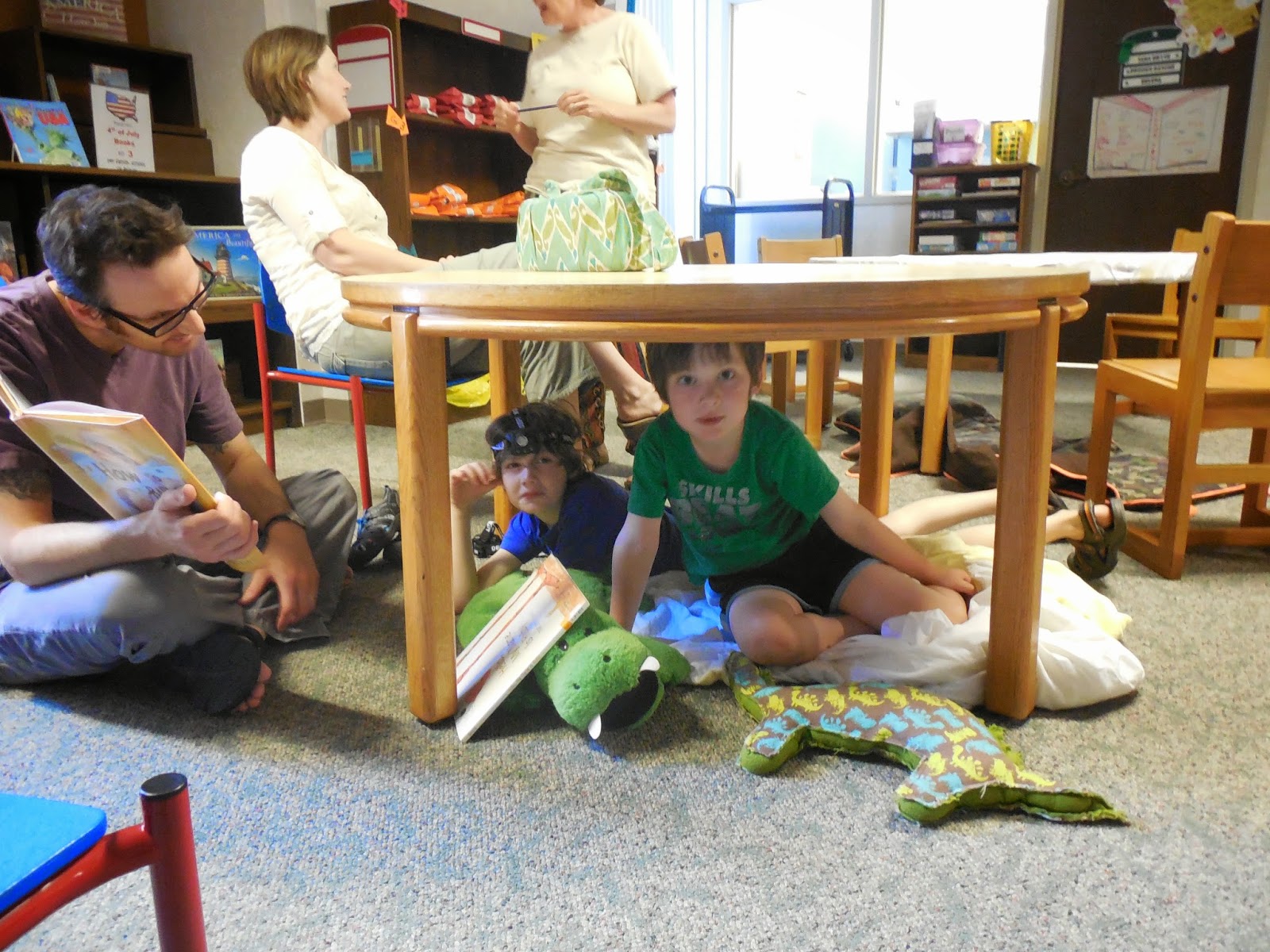
 We do this after hours - the doors lock at 6:00 pm on Friday, we have a brief break and re-open for our campers. Everyone is invited to bring blankets or sheets, flashlights and wear PJs. We have a few teen volunteers who take chairs out from tables to create camping sites (whether under the table or using chairs) or help put blankets between shelves anchored by piles of books to create a cozy reading nook.

The room is darkened with just a little light coming in through the windows. The first half hour is spent building tents, signing up for SLP and reading. We gave everyone a few minutes heads-up to undo their tents near the end of the 30 minutes. Then we invited families into the program room, where spooky stories and walking s'mores were ready (2 boxes of honey graham bears + 2 packages of chocolate chips + one bag of mini-marshmallows = one cup of sweet fun) - and our our fake campfire. A display of fine spooky books were ready for kids to check-out.

We had some younger kids than usual so I started by reading Reynolds/Brown's Creepy Carrots. I let kids know that each story would get creepier so they could leave if it got to be too much. I told the "Coffin Story" and "Tailybone" with the lights low - but kept a bit more on the lighter side. Everyone made it (so brave!).

While the stories were happening our volunteers quickly put the room back together. Families had time to check out a few books (thanks to our director who staffed the check-out and did final lock-up).

This is one of the easiest, most pleasant and laid back unprograms one can do for summer - or any time of the year. Kids and families love the magic of an empty library and those that come love the reading and the program.  For more samples of how to do it, drop by earlier posts here and here and Amy did her own fun take on it last year.


5.01.2014

Thrive Thursday May Round-Up


I am happy to host the May Day edition of the Thrive Thursday blog hop. It's a chance for us to read about programs, thoughts and initiatives happening for our school-age audience. Enjoy!

ACTIVE PROGRAMS
Who doesn't love Geronimo Stilton - and all his friends! Lisa over at Thrive After Three blog breaks down a great four week series for us.

Carol at Program Palooza did two Earth Day-related programs here and here that combine fiction, non-fiction and a re-cycled craft.

More Earth Day friendly crafts are on tap at Ms. Kelly at the Library's blog.

And Lisa suggests a Lorax Book Vs. Movie program that has a nice Earth Day connection too!

Why not re-purpose a fun craft-it program for Money Smart Week by having the kids "buy" their supplies to bring math into the STEAM picture? Amy of Show Me Librarian shares in a guest post at Library as Incubator blog

Disability awareness becomes part of this program from Carol at Program Palooza.

American Girl Addy is the focus at Ms. Kelly at the Library's program.

Unprogramming might with Elephant and Piggie shows up at my blog Tiny Tips.

Movies...er, I mean book trailers!! Dawn over at Story Time with and Signs and Rhymes shares how 5th graders made book trailers of her book.

Create a Picture Book workshop series...seriously! Story Time with and Signs and Rhymes Dawn takes readers on a step by step process on creating a workshop where kids learn the ins and outs of authorship!

With summer coming up, this ALSC webinar inspired wiki space on STEM programs will inspire you.


STEALTH/PASSIVE PROGRAMS
Need some passive programs for spring break? Sara at S. Bryce Kozla to the rescue!

Angie at Fat Girl Reading has two more spring break stealth programs that are a cinch to set up.

Need a poetry passive program/display? Mel at Mel's Desk shares her colleague Julie's great work!

Less Screen Time Week is how Wisconsin librarian Sue Abrahamson is rethinking Screen Free Week, May 5-9, as guest poster on Tiny Tips for Library Fun.


PROGRAM THOUGHTS
Over at Kids Library Program Mojo, a blog for librarians taking a youth services programming CE course:  Michelle shared thoughts about the pressures on parents and program attendance; and Erin reflects on how we can meet parents where they are in our programming.

Re-imagining library tours into a truly phenomenal experience takes time and effort that I reflect on here at Tiny Tips.

And to bring us home, Sara at S. Bryce Kolza starts solving for the equation of school family literacy outreach awesomeness using some Brewfest math.


Stay tuned for the June blog hop hosted at Thrive After Three. And if you'd like to host a month, contact Lisa Shaia, our intrepid founder and scheduler to throw your hat in the hosting ring: lisamshaia (at) gmail (dot com). We also have a Pinterest board and a Facebook Group, so join in on the fun!


4.04.2014

On the Road with Unprogramming!

I love the opportunity to get out and share with library colleagues. But as many of you know, it's even more fun to get out of the library world and share with folks outside of libraries.

I'll be presenting tomorrow at the Wisconsin Afterschool Association conference in Lake Geneva. This two day conference is for providers as well as folks working in youth serving organizations like the Y and teen centers who work regularly with afterschool kids.

The fact that I will be at this conference is pure kismet. I was visiting a friend last fall and her dining room table was full of applications for presentations. Turns out she is the chair of this year's WAA conference. In our conversation, it was clear that libraries should not just be part of the association and conferences but also have a place at the table given our work with this demographic.

So "Book It! Creating Fun, Book Based Programs for School Agers" was born. Here's the description: Promote literacy and fun! Learn easy preparation ideas, how to adapt books to parties and tips on “unprogramming” (letting kids guide discovery). Best of all - leave with plans!

I'll be talking unprogramming ways to keep programs managable: collecting great sources from blogs and Pinterest; reasonable prep time; giving kids agency to discover and creating stations of stuff. The book party themes we'll talk about:  dinosaurs, Elephant and Piggie, Dr. Seuss and Diary of a Wimpy Kid programs. The Pinterest board is ready. So am I.

Let's meet new friends and potential partners and share the library good word!

Graphic courtesy of Pixabay

4.01.2014

Elephant and Piggie Party!

I love programming with school age kids - both early elementary friends and older elementary. One of my all-time favorites is Elephant and Piggie from the delightful early elementary books written by Mo Willems. Why?

First, kids love this goofy pair. Second, I love this goofy pair. Third, lots of you out in the blogosphere have shared your wonderful programs. My Pinterest board is happily full of enough fantastic ideas to do this book-themed party many times with many different activities!

Finally, this program is is a perfect example of #unprogramming - lots of ideas stored away to use, capitalizing on strong kid interest, books to share with kids, children free to explore and interact with stations and extremely small preparation.

 
To begin we read three books:
We are in a Book
There is Bird on Your Head
I Broke My Trunk


I set up three stations of stuff for kids and parents to play with:
1) Elephant and Piggie paper bag puppets. Because we have a fantastic business manager, we just happened to have pink and blue bags to make this easier. We found the ideas and patterns here.
 
 
2. Bird on My Head Hat. Using a bowl, pom poms, crepe paper for nesting, yarn  and a pigeon cut-out, kids could make a nest for their heads. I mean really, who can resist this?!?! Thanks Abby!


3. Get Well Card for Elephant - markers, card sized sheets and stickers were all we needed.
 
Kids happily listened, explored and made for the entire program. My biggest job was taking a few photos to preserve the moment. When programs celebrate books, the kids feel like winners and this librarian feels like a superhero - connecting kids and a love of books!


3.12.2014

Dynamic Dinosauria!*

Any day or time is a great time for a dinosaur program. While I love doing them for any age, I especially enjoy doing these programs for school agers - the non-fiction elements are just too good to pass up and it's a wonderful STEM opportunity.

Here is how we did our most recent dinosaur program:
Dinosaurs of Waterhouse Hawkins.  Barbary Kerley; Illus by Brian Selznick
This Caldecott honor is great to book talk. Two hundred years ago, people hadn't the slightest idea on what dinosaurs looked like. English artist Hawkins studied the bone fragments and structures and used his own knowledge of animals to build life size models of what dinosaurs looked like. He held a dinner party in a hollowed out dinosaur to create excitiement and eventually created a huge garden to display the behemoths to the public.


Bones Bones Dinosaur Bones. Byron Barton
This is a great short picture book on archaeology and fossil hunting.

Activity: Have kids glue dry penne pasta (bones) onto a dinosaur outline. Doing it early in the program gives the glue plenty of time to dry. It also gives us a chance to talk about how hard it was for scientists to figure out exactly how all the fragments theyuncovered fit together. Imagine putting a dinosaur skeleton together without an outline. What bone connects to what bone?!?! Thanks to Sunflower Storytime for this much used idea here at LPL!

How Big Were the Dinosaurs. Bernard Most (very humorous) OR
How Big Were Dinosaurs. Lita Judge (great contrasts)
Read either of these books that examine and compare the size of dinosaurs.

Activitiy: Have a ball of string or yarn 130 feet long (don't tell the kids how long). Tie it at one end of the room and have kids take turns unrolling it as you "measure a dinosaur.  This was the size of a diplodocus. Lots of ooohs and aaahs along the way. Then bring the kids and string back and have them measure how long the string is with yard stick and tape measure. Talk about what else they think might be that long around the community.

Unrolling the string
Activity: As the final ending activity, I cannot resist asking kids to be fossil hunters. We talk about the painstaking careful excavation of fossils and dinosaur bones with small picks, trowels and even brushes to carefully reveal small fragments. Everyone receives a chocolate chip cookie and a toothpick. We ask each child to carefully excavate one chocolate chip from the cookie with the toothpick - and then gobble up the results.

With lots of non fiction books on display ready for check-out this is a sure fire hit and an easy way to do science with fierce fans of dinaosaurs!

* a huge tip of the hat and genuflecting reverence to Sandy Berman who back in the day fought mightily - and often successfully-  to push LC subject headings from the academically bizarre to the practical, useful and reality-reflecting modern day. As a young librarian, there WAS no such thing as a subject heading called "Dinosaurs". No my friends, it was really, really truly "Dinosauria". Here's to Sandy and his amazing leadership that still stands us in good stead.

3.07.2014

On the Road in Arkansas


Today I join colleagues at the Arkansas State Library Children's Services Workshop in Little Rock. I'm sharing presentations on Unprogramming, Stealth Programming and Dynamic Partnerships (including Schools!) and many of the programs I refer to can be found on these Pinterest boards. My Arkansas friends are also sharing ideas on science, makerspaces, and 1000 Books Before Kindergarten and sharing weather that is far more spring-like than anything I expect to see for some weeks home in Wisconsin. What could be better? If you don't do Pinterest, below are links to some of the resources that are described in today's workshop.

And while I'm on presentations and workshops, I want to encourage everyone to read this vital post at Storytime Underground by Amy Koester about your own power to share your good work with each other. I am a working librarian like you who does just that. So keep on standing up, sharing ideas and feeling your power!

Unprogramming
Space Trip
Library Camp-out Fun
Ninjago!
Dr. Who Party
Diary of a Wimpy Kid
Slideshare

Stealth/Passive Programs
1000 Books Before Kindergarten
Free-quent Reader Club
Cookie Club
Gnome Hunter's Club
Reading is Key Club
Story Action Pods
Slideshare

Dynamic Partnerships
Global Friendship Fair and Science Festival
Marsh Meander and Library Camp
Experts: Check out an Amphibian, Fencing, Yoga
Arts and Artists
School Collaboration
Slideshare


3.03.2014

So Seuss-ified


We like to do a little Seuss fun around his birthday and the national efforts surrounding Read Across America Day. As Sara pointed out as we were planning our spring (ha!) programs, that day serendipitously fell on a Sunday this year - program - better yet, #unprogram!!

Over the years of my active storytelling (semi-retired from that freelancing now but it helped pay off my student loans!), I always got lots of bookings around this time at schools. I have a bagful of goodies to create Dr. Seuss fun so I am always up for all things Seuss especially when there is a larger national effort to spotlight his books.

I remember the days when his books flew off the shelves all the time. In our community, Seuss books are shelf sitters for the most part during the year. There is a flurry of action in February leading up to his birthday (we put limits on numbers of Seuss titles checked out by any one patron at any one time during this time). Then during the first few days of March everyone remembers the good doctor again and, with the spotlight on, a program of Seuss fun is always welcome and always well attended.

Here is my sure fire success recipe for the Dr. Seuss program for ages 3-8 where the focus is firmly on the books and their inherent goofiness. Hope you can use it too!

Books:
I Wish That I had Duck Feet by Theo. LeSieg
The funniest "I-didn't-know-that-was-a-Dr.-Seuss" book. I love to talk about how Dr. Seuss' real name was Theodore Geisel and that he loved to play with words and letters in his books and in  his name too. I point out that LeSieg is his last name spelled backwards. If we do a related activity with this book, I have them write their first or last name backward and come up with their own pen name!

I "tell" this book rather than read it although I use the book to show the very fun pictures. I have props I use to represent the deer horns, whale spout, tail, duck feet and elephant nose and often have kids come on up from the audience to hold on to them during the story. It is a screaming easy story to use and always kicks off the program with a bang.
I mine the book Sneetches: and Other Stories for two of my favorite stories. The first is one of the shortest and most unknown stories Dr. Seuss ever wrote: Too Many Daves about the unfortunately unimaginative parent who named all her offspring Dave and now wishes she had given them more unique names. I have little cards I make with all the 23 names and give them out to kids in the audience - well, and grown-ups and babies too (Babies get "Stinky" and an adults get "Oliver Boliver Butt" and "Paris Garters" and no one's feelings are hurt). Everybody loves this.

The second one is the scariest, spookiest story Dr. Seuss ever wrote: What Was I Scared Of? about a particularly ominous pair of pale green pants - with nobody inside them! We dim the lights a bit and off we go.

Stretch: One Fish Two Fish Red Fish Blue Fish Dr. Seuss-y
I make up red fish cards and blue fish cards and kids get one of each. To the tune of the hokey pokey, we put our one fish out, then two fish, then red, then blue fish. Great fun for the kids and a nice link to the book that we have on display.

Goodbyes: kids always get a star sticker on their belly.

That is our half hour in a nutshell. I usually pick up a Read Across America packet at the ALA conference and copy an activity sheet or two for kids take home and sometimes have a giant birthday card to sign. It's a great easy way to link into a national PR effort, create fun with almost no preparation effort and celebrate books - a perfect unprogram event!


2.24.2014

Give It Away, Give It Away, Give It Away Now


How often do you go to a program, read a blog post, see a blog comment or in conversation with your colleagues hear, "I stole this program."

You guys, no you didn't!!!!

I feel very strongly about this issue.  We all share so that we all can learn. This issue came up in our programming class and one of the student-librarians wrote this post on our class blog Kids Library Program Mojo.

Each description or workshop or blog post on a program or idea is really an open invitation to take the idea and grow it for YOUR community.

Remember, if you don't use that idea, it stays hidden and the children in your community never get the benefit of that innovation.  Hidden ideas seldom grow, evolve and change.

It's within the scrum of sharing, borrowing and giving away of ideas that we see the true evolution of innovation in children's library work. Be good and credit your source and the originator always and then grow it!

Sandy Krost started 1000 Books Before Kindergarten - look where it is now.

Sara Bryce pioneered Story Action Pods - look where it is now.

Cory Eckert started the Guerrilla Storytime movement - look where it is now.

Mel Depper started the Flannel Friday movement - look where it is now.

Lisa Shaia just started the school age Thrive Thursday movement - look where it is now.

I had a hand in starting the Unprogramming concept - look where it is now.

I could go on...but these are all incredible new, crowd-sourced initiatives that have grown like topsy because we share - and give ownership and agency away.  It is good to know you started the snowball rolling but why do you have to hoard the snow that goes into making it bigger, better and shared across the area, state, region or nation?

Any one of these things would still exist if it were "owned" by its founder in some small way, in one small community, in one lonely place.  But by giving it away, inviting participation, sharing and sharing, all of these innovative children's initiatives, projects, programs and concepts have taken on a vibrant life of their own.

We are stronger together. So free yourself.  Give it away. Take it. Share it. Grow it. Fairly credit it. And be mighty.


1.15.2014

Going Wild in Wisconsin


Today I joined friend and colleague Amy Koester in presenting a webinar exploring Unprogramming during Wisconsin's two day state-wide CE extravaganza, the Wild Wisconsin Winter Web conference. Organizer Jamie Matczak brought in speakers from around the country (well, and from Belgium!) to explore cutting edge issues and ideas.

Amy and I have been spending alot of time over the last year or two loosening up and streamlining our program planning with school-agers (both in elementary and middle school). By incorporating unprogramming concepts (celebrating books, giving kids agency to explore through discussion and hands-on discovery), we have been able to decrease excessive program preparation and planning.

Here is the simple recipe we use to guide our efforts:


I can't praise this approach highly enough. For me, it has been freeing. I look forward to presenting programs because I am comfortable in the content and the kids' engagement. Because of our increasingly networked work world, I can easily find interesting information on books, authors and subjects. Creating fun activities is as close as a blog, Pinterest pin or publisher's site.

Kids love the approach. We give them the power to explore and they respond happily. I love the chatting and conversations, problem solving and exploration that results from their participation. It enriches the program far more than having me as a talking head.

As a manager, I can see the savings - in time, because preparation is less intense and time consuming; in staff, since fewer staff need to be involved in a program; in money, because many supplies and materials can be re-purposed and in stress, because the programs invite kids to provide the vehicle for their own discovery.

For people attending the webinar, here are links to specific programs I discussed: Space, Dr. Who, Library Camp-out.  Please stop by Amy's blog, The Show Me Librarian, for additional links and information from today's webinar!

From a Conversation Starter at ALA (a tag team seven- post series at our blogs starts at this post to continued dialogue at this webinar, unprogramming is always a great chat!

1.13.2014

Namaste! Yoga @the Library


A few months ago, a friend volunteered (the idea and her time!) to do yoga while I told a story for the kids. I thought it had the perfect pieces for an early elementary program so we scheduled it into our monthly "Second Saturday @ the Library" rotation .

We chose the story the Lion's Whisker from Sydney Solis' Storytime Yoga: Teaching Yoga to Children through Story. The book has short tales and lists suggested poses to go with it. It also has suggestions for  guided meditations for the final savasana pose to use with wiggly kids!

After a welcome, a few upcoming program ads and a bit about my own yoga journey, Rachel, my yoga instructor friend, took over. She introduced herself and her background in yoga and then asked the kids and parents to share their name and a favorite way they like to move. Some kids and parents had done yoga and some not but it introduced the concept of how great it is to move and stretch your body. That ice breaker was filled with movement and laughter and really brought the group together.

Rachel next talked about our minds being like monkeys that like to dart around so we put our monkeys on a leash when we are doing yoga. That calmed the group down and I shared the story once through. Then Rachel worked with the group to do poses associated with the story - tadasana, virabhadrasana I & II, utthita trikonasana, balasana .

Next, while I slowly retold the story with words, Rachel and the kids echoed it through the poses along with some free form emoting (after all, this is a story of a stepmother desperate to attain the affection of her stepson!). We finished with a soft meditation while everyone relaxed in savasana.

We all enjoyed the program and parents and kids asked if we would do this again. So we are scheduling a three week afterschool series later in spring.

I love programs that tap into community expertise and use the best of unprogramming to create value for participants, a way to focus on our collection (yoga and meditation) combined with easy preparation and a fun program partner!


11.19.2013

Learning When to Say "End!!"


One of the truly bright spots of youth librarianship is the sheer fun and creativity - the inventiveness  - of our programming work with kids and families.  Program series and "one-up" events for school-agers let us experiment with unprogramming, DIY, STEAM and lots more stuff we make up with joie de vivre, an eye for literacy and a celebration of our collections. Storytimes present an ever-flowing river of great new books to try, a fingerplay or way to deliver a literacy tip, new CDs to share, a new way to engage the kids. Over at Storytime Underground, a great example of this flow is their "Pimp My Storytime" post (go over and play now!).

But, we also know that, as good as our ideas are and as often as they work swell, the time comes when the program or format just isn't making it anymore - either for the patrons or for us.  The trick is to know when to say when - when to make a major change in direction or end a limping program.

What are some of ways that you feel the winds of we-may-need-to-change?
  • Attendance drops off.
  • The format of your school-age programs hits even you as routine.
  • You begin to dread your next storytime session.
  • The preschoolers seem antsy ALL the time (no blaming barometric pressure or the full moon there).
  • Trying new times, days, or scheduling patterns don't resurrect patron interest.
  • The same small group of dedicated patrons come, but no one new ever does.
  • Budget cuts loom and something has to go or be cut back.
As a librarian and a manager, I have presided over countless changes in my own programming and in the departments I oversee. I find change exhilarating, evolutionary and necessary to move youth services ahead. Despite those feelings, I also know: Change.Is. Hard.  It is scary ("Is that a cliff I see ahead?!?!"). It is unknown ("Is this gonna work?!?!).  It is stressful ("Are patrons gonna hate on me?!?!").

At the same time, these program tweaks, changes and endings can allow an opening up of possibilities. New information, new ways of providing service or new ways to emphasize collections can be developed and enfolded into a re-working of a program or program schedule.

This reflection on worth is something that ideally is ongoing. When we talk about changing or ending something, we often find the opportunity to add something else - new outreach to kids in schools/daycare; a stealth program; clear the schedule to bring in a whole district-full of field trip visits (Kindergartners! 2nd Graders! 7th Graders!); time to write a grant for a way new initiative. 

When we talk to our patrons about the changes, they are often happy to see the additions and changes. Sometimes we have a few who question why we are making a change or express unhappiness. We find that, as a staff- and at all service points, explaining why we are doing what we are doing often makes a difference in understanding.

Sometimes our fear of the unknown, fear of community reaction or our own sense of being wedded to a certain program we birthed and proudly watched grow prevent us from making the change or bringing the end to a program.  But if we want to move forward, if we want to balance what we do so we can add a fresh program or start, it is OK to put a final period on a certain program.

How about you?  Are you able to do guilt-free program ending/change?

Graphic courtesy of Pixabay

9.04.2013

Let's Hear it for School-Age Programming


Amy over at Show Me Librarian has a call to action for libraries to not just do fabulous early literacy programming but also make sure that school age programming is as strong a priority. In the post she questions whether the emphasis on early literacy recently has resulted in neglect for our school age clientele.

Just to continue the conversation Amy started, I think it is well worth considering where the emphasis on school-age programming went to.  I think it stretches back further than the past ten years when ECRR woke us up to the possibilities of making our storytimes and work with parents and tots more..uber.

In the late 1980s, the Public Library Association developed a list of roles for public libraries. Libraries and focus groups in a community went through a role selection process to determine the 1-3 roles that best described their service and service goals. The eight roles listed:
  • Community Activities Center
  • Community Information Center
  • Formal Education Center
  • Independent Learning Center
  • Popular materials Library
  • Preschoolers Door to Learning
  • Reference Library
  • Research Center
could be considered all-ages encompassing. But in reality, only one spoke strongly to youth concerns.  The role that a huge majority of libraries selected was Preschoolers Door to Learning. After all, we are THE library for this age group.

So libraries started strengthening and improving their service to our youngest audience. And I wonder whether this is where some of the school-age programming started to slip. There was no true role for this age group.

The roles have been replaced with newer paradigms as years have gone on but not all libraries got that message. Even here at my library as recently as the last year, a staffer cited the Preschooler Door to Learning as the reason we had to concentrate more staff hours on preschool services.

We have tried hard at the libraries I work at to serve all ages with excellent programs. Because kids are in school doesn't mean we should stop serving them during the school year.  We collaborate with the schools; present programs during school breaks and early release days; and present afterschool workshops and events on weekends. We also make sure to have a healthy dose of stealth programs running nearly year-round to involve busy school-age kids in visits to our library.

This is all much on my mind of late. I am developing a six week online course of programming and great swaths of it will deal with creating programs for school aged kids and developing programs for preschoolers beyond storytime. Much of that territory is still ripe for exploration (think unprogramming and it's impact).

I am so happy to see how strong the early literacy component of storytimes is and how powerful the voices of early literacy advocates have become in libraries around the country. The sharing of great ideas through Flannel Friday and Underground Storytime has put power into the hands of librarians.

But I'll still keep looking for those innovative school age program and service ideas from people like Amy and Abby and Bryce and ALSC and others who are pushing the service envelope to school-agers. Hope you share your great school age ideas too!

Image: 'Turn On The Bright Lights'  http://www.flickr.com/photos/49722723@N00/261265808 Found on flickrcc.net

9.02.2013

Thinking About Science


With next year's CLSP (Collaborative Summer Library Program)  theme centering on science, I am starting to gather ideas and thoughts and pins on sources for fun programs.  I have this idea that we are going to create a robot-mascot of some sort and use it in many thematic ways.

One idea I have is putting a robot head on the wall. Then as kids read and we set group goals, we start adding a body part on after so many minutes read. The more kids read, the more complete the robot will be - first a boot, then a leg, then a hand,then an arm and onward. Let's see if that motivates the reading troops!

But more than that, we get to do science all summer.

I know it will be a gimme for programs and activities. That's because STEM and STEAM have entered our public library vocabulary.  It has freed us to look not just at fiction-based programming but at non-fiction-based science: makering, experiments and unprogramming (where kids take the lead in discovery and learning in programs).

A recent post by Allison over at No Time for Flashcards got me excited about the prospects of science for our tots. It goes hand in hand with another favorite blog, library makers Wonder Works, where the littlest kids delve into science and go where few tots and gone before.  I also depend on Amy over at Show Me Librarian (and a frequent ALSC blog contributor on the subject) who generously shares STEAM programs through her blog posts on programs at her library.

You can drop my SLP 2014 Pinterest board over the coming year to see what mischief I'm collecting.

Where are your go to blogs and websites for science and kids? Let's share the good stuff!

Photo courtesy of Pixabay


8.05.2013

The Dirt on Dirt #Unprogramming


My Wisconsin colleague Terry Ehle is our guest blogger today. She took unprogramming to heart and shares the dirt...on dirt. Terry has been a youth librarian for 15 years in Two Rivers, WI population 11,696. She says this about herself, “The thing I love most about my job is that it's never boring. If I lose interest in what I am doing I can change it. "What we've always done" does not apply at my library and I love it. I am really passionate about early literacy and want every child in my area to enter school ready to read. I enjoy talking about books with young adult readers and get a secret rush when asked, ‘Do you have any suggestions?.’ I love Zombie fiction and the color pink. Being a librarian is the most challenging job I have ever had and I wouldn't want to do anything else!”
 
After reading the posts about Unprogramming, I decided to share a successful unprogram at my library based on the book “Dirt” by Ellen Lawrence and 2 ideas I found online.  This book is a part of the FUNdemental Experiment s series by Bearport Publishing.  Easy, inexpensive ideas in this book. We had 75 kids attend and my maintenance man is still talking to me so it was a success!
5 Stations:
Egg Shell Geodes – Super simple even for a big group.  The hardest part is getting the egg shells and that wasn’t even that hard.  Crack the eggs near the top so you have more shell to pour into and rinse.  Mix together 1 tbsp. hot (but not boiling) water and 1 tbsp. Epsom salt.  If all the salt dissolves add a little more.  Add a drop of food coloring if you want, pour into egg shell and stick in fridge for a couple of days.  I put the eggs in Dixie cups for the kids to take home.  See picture to see how they turned out.  I also had some real geodes that the kids could explore.
Dirt Catchers – Create a frame using popsicle sticks, add a loop of yarn to hang, tape a piece of packing tape across frame so that one sticky side is facing out and hang in a corner to see how much diit is in the air.
Worm Discovery – Get 2 tubs of night crawlers from a bait shop and set out wet paper towels to put them on.  Let kids use magnifying glasses to observe what the worms do.  The book has some other things to try.  I had an adult supervise this one.
Dirt & Water – Using baby food jars and a few different types of dirt dug up from around town, have kids put dirt in jar and add water.  Cover, shake, observe.  It’s weird but different dirt does different things.
Dirt Discovery – I made copies of a piece of paper with 3 sections – living, non-living, once living and gave each child a cup of dirt.  They poured the dirt onto the paper and dug through it with a toothpick and tried to find things in each category.  One child even found a worm!
The only talking I did was to let everyone know what the stations were.  I had a volunteer at the egg geode and the worm stations.  The only supplies I bought were worms ($5.00) and Epsom salt ($3.00).  Everything else I had on hand.  If it seems complex it wasn’t, other than gathering egg shells from coworkers and eating lots of omelets myself, I pulled this together in 2 days.
More pictures on Flickr:  http://www.flickr.com/photos/lesterpubliclibrary/


7.31.2013

Library Camp-out

This was our second year of doing an after-hours Friday evening camp-out at the library.  About a half hour after the library closes at 6pm, we re-open for kids and families who are ready to read and camp. Campers are invited to bring sheets or blankets and a flashlight.

Everyone enters the children's area where the lights are off (but since it's summer we have plenty of natural light). Teen volunteers have cleared the tops of shelves and pulled chairs out from tables to create maximum scaffolding to create cozy tents and reading nooks. As families come in we invite them to create a tent and read for 20 minutes or so. We have extra sheets and blankets for those who come without (note to self: next year have some extra flashlights in hand).

The tents kids and parents come up with are nothing short of delightful  - I mean talk about the "E" in STEM. Thoughtful engineering goes into each reading nook created with blankets and book anchors.


After about twenty minutes we gather everyone together for a program. Last year we did spooky stories. This year, with our Dig into Reading theme we had another idea!

While colleague Sara Bryce was at a NASA-sponsored workshop the previous year at UW-Madison, she had learned about a loan program from the UW Geology Museum. Need some interesting rocks or geodes? Why, you can check them out for six months!  We had a collection of geodes from near (IA) and far (Madagascar) that we had on "no-touch" display for a month. Now was the time to unlock the case and get up close and personal with these crystalline wonders.

When kids entered the program room, there were geodes everywhere. Sara did a fascinating presentation using styrofoam bowls and food coloring to show how geodes form and booktalked a book on dragons (geodes and dragon eggs).  Then kids and families got to touch and examine the geodes. We gathered them again, handed out Tootsie Pops (how more geode-like could a treat be?) and I shared a story next to our fake camp-fire.

Camp-outs are a great way to create an "exclusive" feeling program where families get the library to themselves. With minimal preparation and kid-led activities (unprogramming!!), everyone comes away feeling great. Well-worth it!

7.13.2013

Unprogramming Part 7: Sharing the Goods


Amy Koester of Show Me Librarian and I are tag-teaming at our blogs this week to report out the Chicago ALA Conversation Starter -Unprogramming: Recipes for School Age Success - that we led on Monday July 2 (see below for links to the whole series).  Please join our continuing conversation in the comments or on Twitter by using the hashtag #unprogramming. 

Amy and I were both so excited to have a chance to share the thoughts behind unprogramming at a national conference level. And we were uber pleased to have a SRO crowd of colleagues come to the program.

What's fun about unprogramming is that it really isn't new. Most of you are doing unprogramming already in big and little ways. We are simply pulling the threads together and encouraging everyone to try this more mellow approach and see real benefits. Just starting the conversation, so to speak.

The audience at our program joined the conversation and shared great ideas of how they have used the unprogramming concept in their programs.  Below are a few quick ideas people shared of programs they are doing:

Painting to Music - kids pull up music on YouTube and then paint while listening to it. Disfferent beats elicit different art responses. The art the kids create is then hung in the room.

Stamping - using Ed Emberley's books as inspiration, kids use stampers and stamp pads to create their own nique creations.

Bibliobop - combining books with music and dance

"Training Camps" - train kids to be a cowboy or pirate or logger or astronaut in these free-form programs that allow kids to pick up "skills" they need to become mighty.

Book Club - kids choose individual books to each read and then videotape interviews with each other booktalking their choice.

Guys Read Club - always done with a book component as well as a "smashing" component (water balloons off a roof; TV drop)

Plus Stuffed Animal Sleepovers, Teddy Bear Clinics, Messy Art Club!

Please share ideas for your unprograms in the comments or under the #unprogramming hashtag on twitter.

We storified the twitter feed for more audience reactions and ideas.  Amy will finish our series today with our slide deck.

Thanks for joining us so we could share the fun of this program from ALA in the blogosphere with all of you. And thanks to Amy for being the best presentation partner one could have!

Unprogramming series
Part 6 - A Collection of Programs & a Testimonial
Part 7 - Sharing the Goods
Part 8 - The End